
See-through or opaque? With Euro containers, people tend to think about size and volume first. But the colour of the material has a practical effect: with translucent containers you can see the contents without opening or pulling out the container. Grey containers keep them hidden. Our translucent containers category offers the see-through versions. This comparison shows when each option makes sense.
What "translucent" means
Translucent means light passes through the material, so the outlines and colours of the contents can be made out. For the translucent lightline containers, the manufacturer describes exactly this benefit: a clear view of the contents, even when containers are closed or stacked.
In our basicline examples, grey and translucent containers match in size, volume and weight. The obvious difference is whether you can see the contents – and therefore how you work in your store.
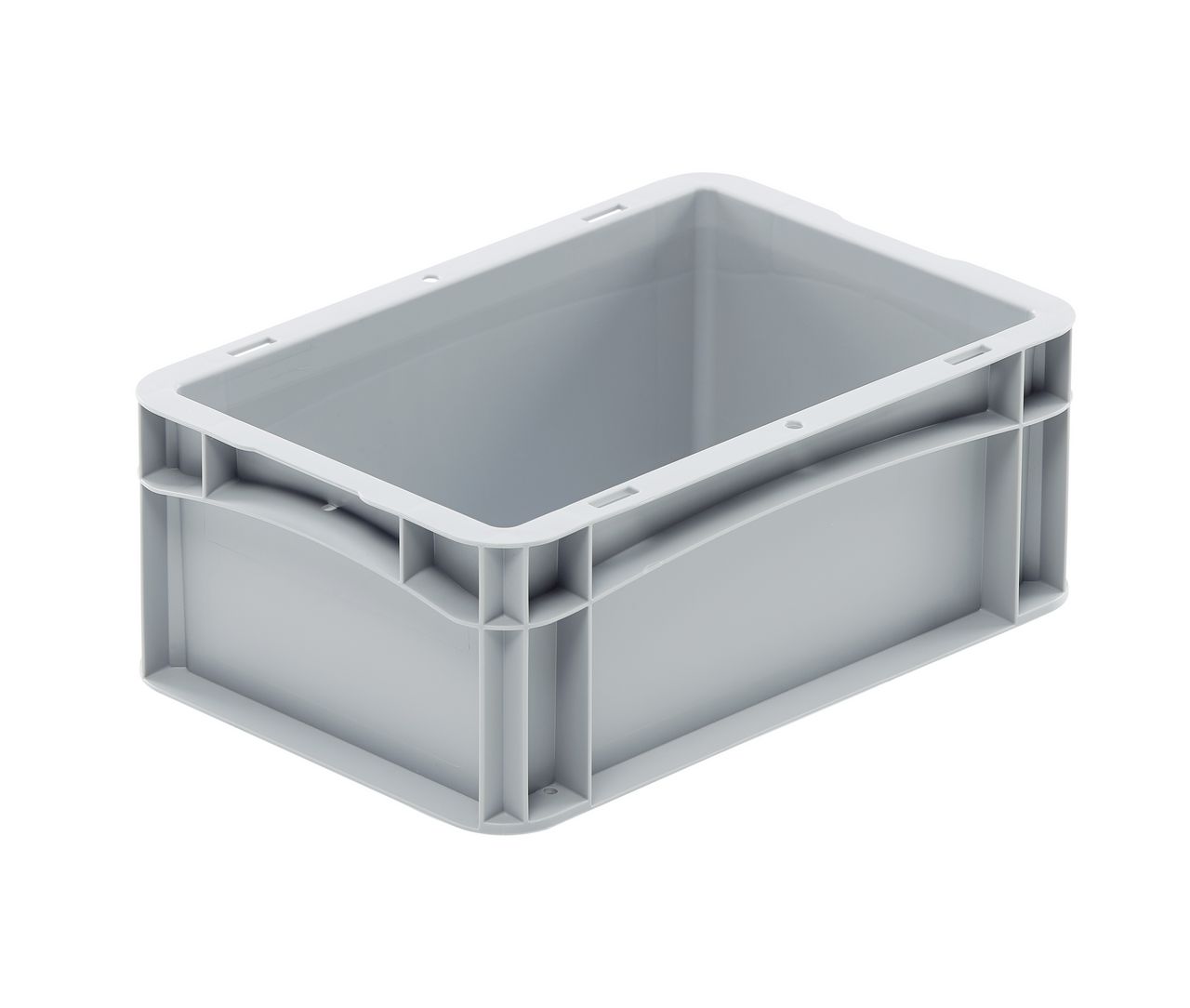
The differences at a glance
The figures come from our product data. All containers are made by Bekuplast from PP-C (polypropylene copolymer).
| Criterion | Translucent | Grey |
|---|---|---|
| Contents visible | yes (for lightline, according to the manufacturer, even when stacked) | no, opaque |
| Example 300 x 200 x 120 mm | 5.1 l, 340 g | 5.1 l, 340 g |
| Example 200 x 150 x 70 mm | 1.3 l, 130 g | 1.3 l, 130 g |
| Sides, base, handles | closed | closed |
| Organising by label | label adds to what you see | label is the only guide |
| Contents hidden from view | visible | hidden |
With identical dimensions, volume and weight are the same. The decision therefore comes down mainly to whether the contents should be visible.
When translucent containers are the better choice
A quick overview on the shelf
When lots of different small parts sit on a shelf, being able to see through the wall saves search time. You can tell at a glance what is inside and whether a container is running low. One example is the Container basicline, closed handle, 300x200x120 mm, translucent colour with a volume of 5.1 litres and a weight of 340 g.
Stacked yet still in view
The larger Container lightline, open handle, 400x300x220 mm, translucent colour holds 24 litres, weighs 790 g and, according to the manufacturer, has a double-wall design and drainage holes. According to its description it suits both manual handling and automatic conveying of light goods.
When grey containers are the better choice
Grey containers are opaque. That has its own advantages: contents stay out of sight in sales or customer areas, and a shelf of uniformly grey containers looks calm and orderly. If you already work with labels and fixed storage locations, you often do not need to see inside.
Grey models in our range
The Container basicline closed, closed handle, 300x200x120 mm, colour grey has the same dimensions as its translucent counterpart. The small Container basicline, sides and base closed, 200x150x70 mm, colour grey has a reinforced frame and corner design, according to the manufacturer, and suits manual handling as well as automatic conveyor systems. The description of its translucent counterpart does not include these details, so the data does not allow a comparison of sturdiness.
What to consider when choosing
- How often do people pick? The more often staff search for and take out parts, the more the see-through wall pays off.
- How many different items? With lots of similar small parts, being able to look inside helps avoid mix-ups.
- Who sees the shelf? If the shelf is in a customer area, an opaque container can look calmer than a view of mixed parts.
- Which format? Choose size and volume to suit the contents first, then the version. The data shows that at the same size, translucent and grey differ neither in volume nor in weight.
If you are unsure, try both versions in one shelf location and compare how quickly parts are found.
Typical applications
Small parts in the workshop
Wall plugs, screws or cable ties sit in lots of small containers. Translucent containers such as the Container basicline, closed handle, 200x150x70 mm, translucent colour show the contents so you do not have to search.
Warehouse with fixed locations
Where every item has its own labelled location, a grey container is enough. The uniform look helps you spot anything out of place quickly.
Production with mixed use
One option is to combine both: translucent containers for frequently picked parts at the workstation, grey ones for reserve stock in the warehouse. Since the dimensions are the same, both fit the same shelving.
Frequently asked questions
Are translucent containers less sturdy than grey ones?
Our product data lists the same material, PP-C, as well as identical dimensions and weights for both. For the small grey container, the description additionally mentions a reinforced frame and corner design; the translucent one does not. Whether that means a difference cannot be derived from the data – if in doubt, the manufacturer's information applies.
Can I mix translucent and grey containers?
Yes. In the same format they fit the same shelving and can be used side by side.
Which sizes are available in translucent?
This article covers 200 x 150 x 70 mm, 300 x 200 x 120 mm and 400 x 300 x 220 mm. You will find the full range in the category.
You will find all translucent containers in our translucent containers category. If you have questions about choosing, call us on +49 2237 628095-00 (Mon–Fri, 9 am–5 pm).