
Ratchet strap or automatic tie-down strap? Both secure loads with a ratchet; the difference lies in how the webbing is handled. With a classic ratchet strap, the loose end hangs free after tensioning and is rolled up by hand. An automatic tie-down strap retracts the webbing itself and holds it with a stop mechanism. Which solution suits you better depends on the load, the lashing force and your workflow. You will find all models under lashing straps / tension belts.
The differences at a glance
The values come from the product data of the Dolezych straps in our shop: DoZurr 1000 and DoZurr 2000 as ratchet straps, DoMatik 25 and DoMatik 35 as automatic tie-down straps.
| Criterion | Ratchet strap (DoZurr) | Automatic tie-down strap (DoMatik) |
|---|---|---|
| Design | 1-piece with pressure ratchet | 2-piece with pressure ratchet and hooks |
| Webbing | loose end, stowed by hand | automatic retraction with stop mechanism |
| Webbing width | 25 mm and 35 mm | 25 mm and 35 mm |
| Lashing capacity (LC) | 1000 daN and 2000 daN | 350 daN and 1,000 daN |
| Strap length | 4,000 mm | 5,000 mm |
| Standard per product data | EN 12195-2 | EN 12195-2 (DoMatik 25: based on EN 12195-2) |
According to the product data, all four straps are made of PES and have an elongation of less than 5 %. The information on the respective product page and on the label is decisive.
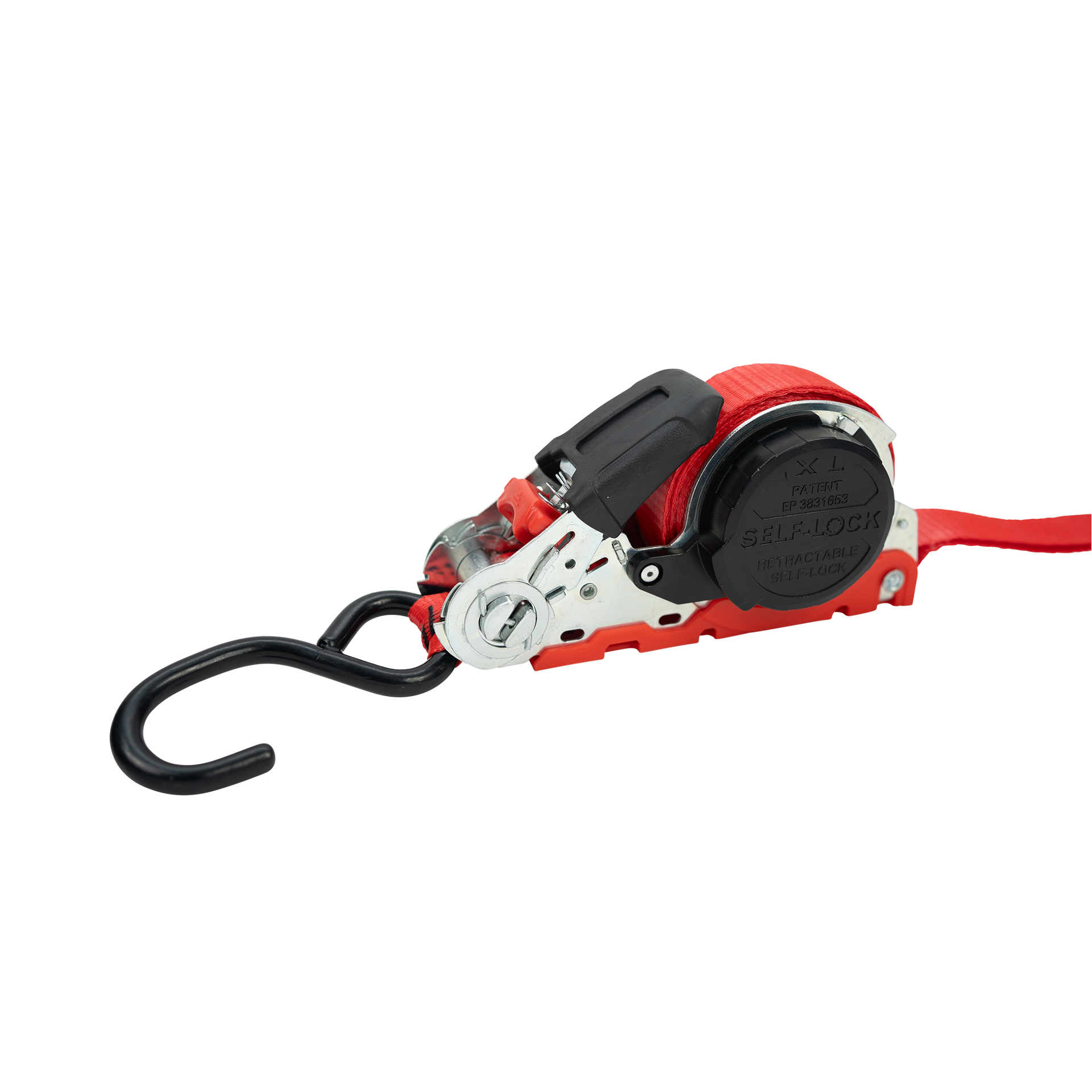
How the ratchet strap works
With a one-piece ratchet strap, the webbing runs around the load or through a lashing point and back into the ratchet. It is tensioned with the ratchet lever. After tensioning, there is a loose end that you roll up and secure so that it does not flap during the journey.
- DoZurr 1000: 1-piece, 25 mm webbing width, LC 1000 daN, strap length 4,000 mm, colour blue.
- DoZurr 2000: 1-piece, 35 mm webbing width, LC 2000 daN, strap length 4,000 mm, colour green.
The strength of these straps is the higher lashing capacity for the same webbing width. The effort lies in handling the loose end, especially when many straps are tensioned and released every day.
How the automatic tie-down strap works
With an automatic tie-down strap, the webbing sits rolled up in the ratchet housing. You pull it out, attach the hooks and tension with the ratchet. When released, the retraction pulls the webbing back in, and the stop mechanism holds it in position.
- DoMatik 25: 2-piece, 25 mm webbing width, PVC-coated S-hooks, LC 350 daN, standard tension force (STF) 119 daN at 25 daN hand force, strap length 5,000 mm, fixed end 300 mm, loose end 4,700 mm, colour red.
- DoMatik 35: 2-piece, 35 mm webbing width, profile hooks, LC 1,000 daN, standard tension force (STF) 280 daN at 50 daN hand force, strap length 5,000 mm, fixed end 300 mm, loose end 4,700 mm, colour orange.
The strength lies in the tidy webbing and the quick switch between tensioning and releasing. In return, the lashing capacities in our examples are lower for the same webbing width.
What matters when deciding
- Lashing force: which lashing capacity and which tension force does your load need? This depends on weight, lashing method and number of straps.
- Lashing points: does the vehicle have lashing points for hooks? Then two-piece straps are a good fit. If you lash around the load, a one-piece strap is practical.
- Frequency: if you tension and release often, automatic retraction saves handling steps.
- Label and condition: whichever system you use, check the label, webbing, ratchet and hooks before every use.
Typical applications
Van in everyday workshop and installation work
Toolboxes, equipment and material are loaded and unloaded several times a day. This is where the automatic tie-down strap shows its strength: hooks into the lashing points, tension, release, and the webbing disappears back into the housing. For lighter loads, the DoMatik 25 is sufficient; for more lashing capacity, choose the DoMatik 35.
Truck loads and bundling in the warehouse
Heavier goods on the loading floor or bundles in the warehouse need a higher lashing capacity. In the warehouse, a one-piece ratchet strap such as the DoZurr 2000 with LC 2000 daN bundles the goods. On the loading floor, run it over the load and through the vehicle's lashing points, because only then is the load connected to the vehicle. Stow the loose end carefully after tensioning.
Frequently asked questions
Is an automatic tie-down strap safer than a ratchet strap?
The system alone does not make securing safer. What matters is the right lashing capacity, the correct lashing method and the strap being in perfect condition. The automatic function mainly makes handling easier.
Why does the DoZurr have no hooks?
The product data describes the DoZurr 1000 and DoZurr 2000 as one-piece straps. They are run around the load or through a lashing point and closed in the ratchet.
What does “based on EN 12195-2” mean for the DoMatik 25?
That is how the product data puts it. Ask us before buying if your application requires a strap with an explicit reference to the standard. The DoMatik 35 names EN 12195-2 directly.
The straps in our shop
This article is a selection guide – the manufacturer's operating instructions apply for use and inspection.
- DoZurr 1000 with pressure ratchet, 1-piece, 4.00 m
- DoZurr 2000 with pressure ratchet, 1-piece, 4.00 m
- DoMatik 25 automatic tensioning belt
- DoMatik 35 automatic ratchet lashing strap
More straps are shown in the lashing straps / tension belts category. We are happy to advise you: +49 2237 628095-00, Monday to Friday from 9 am to 5 pm.