
In load securing, anti-slip mats and lashing straps work as a team. The mat increases friction between the load and the loading surface, while the strap presses the load down and keeps it in place. Only the combination of both makes for well-planned securing. You will find suitable mats in our anti-slip mats category. This guide is not about the mat on its own, but about how to combine mat and strap sensibly.
Why mats and straps belong together
Every load tends to move when braking, accelerating and cornering. Two things counteract these forces: the friction between load and surface, and the force that presses the load onto the surface or holds it in place.
- The mat changes the friction. A smooth wooden or metal loading floor lets crates, pallets and machines slide more easily. An anti-slip mat underneath raises the friction of the contact surface.
- The lashing strap supplies the contact pressure. With tie-down lashing, the strap runs over the load and presses it onto the surface. The harder the load is pressed down, the more friction the mat can actually build up.
A mat without a strap therefore holds a load only through its own weight. A strap without a mat, on the other hand, has to do more of the work alone. Combining both makes use of the strengths of each. How many straps you actually need depends on the weight, shape and position of the load and has to be worked out case by case.
What the product data says about the mats
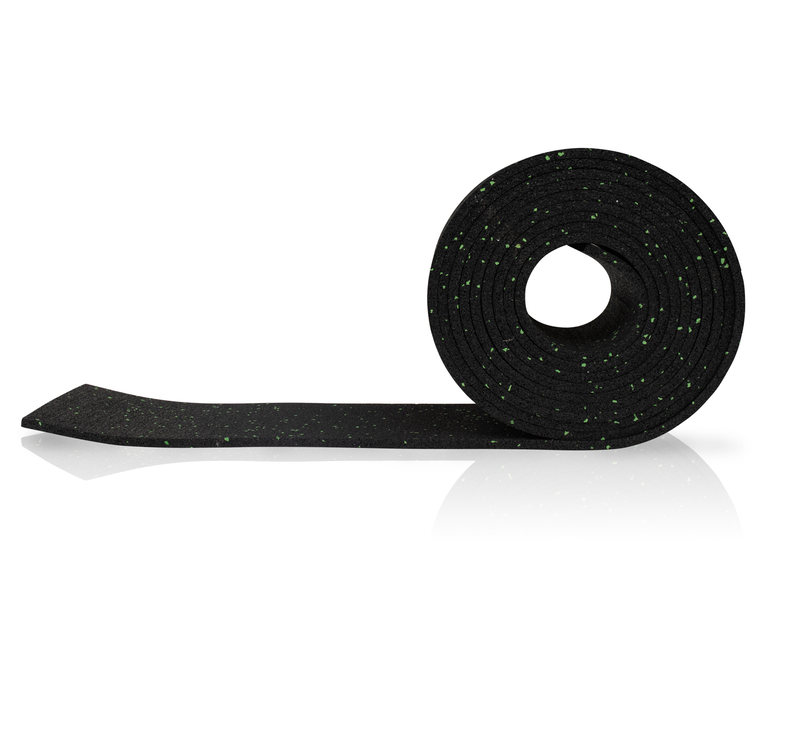
For the DoMatt mats by Dolezych, the product data lists two formats. According to the manufacturer, both have a sliding friction coefficient of 0.6 and refer to the guideline VDI 2700, sheet 14+15.
- DoMatt anti-slip mats in 4 mm thickness 1250 x 1250 mm: a square black sheet, 1250 mm long and wide. It covers a larger contact area.
- DoMatt anti-slip mats in 8 mm thickness 5000 x 250 mm: long strips, 5000 mm long and 250 mm wide. Strips can be placed precisely under skids, pallets or support points.
A sliding friction coefficient describes how strongly two surfaces grip each other while sliding. The stated value applies to the mat under the manufacturer's conditions. On a dirty, wet or oily loading floor, the effect can be different. So make sure the floor, the mat and the underside of the load are clean and dry.
What the product data says about the strap
As a partner for the mat, we use the DoZurr 5000 with pressure ratchet + profile hook, length: 8 m as an example. According to the product data:
- Design: 2-piece, 50 mm webbing width, PES webbing, colour orange
- Lashing capacity (LC): 2500 daN
- Standard tension force (STF): 300 daN at a hand force of 50 daN
- Elongation: less than 5 %
- Lengths: strap 8000 mm, fixed end 500 mm, loose end 7500 mm
- Standard: EN 12195-2
For tie-down lashing on a mat, the standard tension force matters most. It describes the tension in the strap after tensioning with the stated hand force. How hard the load is actually pressed down also depends on the lashing angle and the number of strap sections. The lashing capacity is the highest force the strap may be loaded with according to its marking. Both values are printed on the strap's label. Before every use, check that the label is legible and that the webbing shows no cuts or abrasion.
How to combine mat and strap
- Prepare the loading floor: sweep it clean and remove moisture and oil.
- Lay out the mat: the mat goes under every support point of the load. For pallets, strips under the skids or blocks are often enough; for crates, a sheet under the footprint.
- Set the load down, do not push it: pushing a load across the mat can shift or damage it. Lower the load from above.
- Attach the straps: run the strap over the load, hook it into suitable lashing points and tension it with the ratchet. Use edge protection wherever the strap runs over sharp edges.
- Re-tension: check the tension after the first stretch of the journey and during breaks. Loads can settle, and the mat can compress slightly.
- Check the mat: replace damaged, dirty or heavily compressed mats.
The mat does not replace the strap, and the strap does not replace planning. Loads with a high centre of gravity or an awkward shape need additional measures, such as form-fit stowing against the headboard.
Typical applications
Truck with a mixed pallet load
Pallets of different heights stand on the loading floor. Strips of the 8 mm mat under the skids raise the friction, and a lashing strap runs over each row of pallets for tie-down lashing. This way, mat and strap work together without the mat having to cover the whole floor.
Workshop or machine transport in a van
A single crate or machine stands on a smooth floor. A 4 mm sheet under the footprint and straps to the vehicle's lashing points hold the load. With the sheet under the entire contact area, the friction is spread evenly.
Frequently asked questions
Is an anti-slip mat enough without a lashing strap?
Usually not. The mat increases friction, but without additional contact pressure its effect depends solely on the weight of the load. So always plan straps or other securing equipment as well.
Which mat thickness should I choose?
The product data lists 4 mm for the sheet and 8 mm for the strips. The choice mainly depends on the load and its supports: sheets for full footprints, strips for skids and support points. The manufacturer's information on the product page is decisive.
How can I tell that a strap must no longer be used?
A missing or illegible label, cuts, heavy abrasion and deformed hooks or ratchets are typical reasons to withdraw a strap. The details are set out in the manufacturer's operating instructions.
Suitable products in our shop
This article is a selection guide – the manufacturer's operating instructions apply for use and inspection.
You will find all mats under anti-slip mats. The matching strap for the mat is the DoZurr 5000 with pressure ratchet + profile hook. If you have any questions, call us on +49 2237 628095-00, Monday to Friday from 9 am to 5 pm.