
Which width and thickness does your strapping need? The answer depends on the package: a stack of light cartons places different demands on the strap than a heavy pallet of machine parts. Using four straps from our strapping bands category, this guide shows how width, thickness and breaking strength are related and what to look for when it comes to the coil and core. The material is only a side issue here, the focus is on dimensions.
Why width and thickness go together
Strapping is described by two dimensions: the strap width and the strap thickness. Both appear one after the other in the product name, for example 12×0.73 mm. The first figure is the width, the second the thickness of the strap.
For the same material, these two dimensions together define the cross-section of the strap and therefore how much tension it can take. The product data show this clearly: at the same width of 12 mm, the PP strap with a thickness of 0.55 mm has a maximum breaking strength of 133, while the one with a thickness of 0.73 mm reaches 198. The data sheets give the unit as kg/daN.
For your choice, this means that if you need more strength within the same material, you can go for a thicker or a wider strap. Which option makes sense also depends on the width your tool or machine can handle.
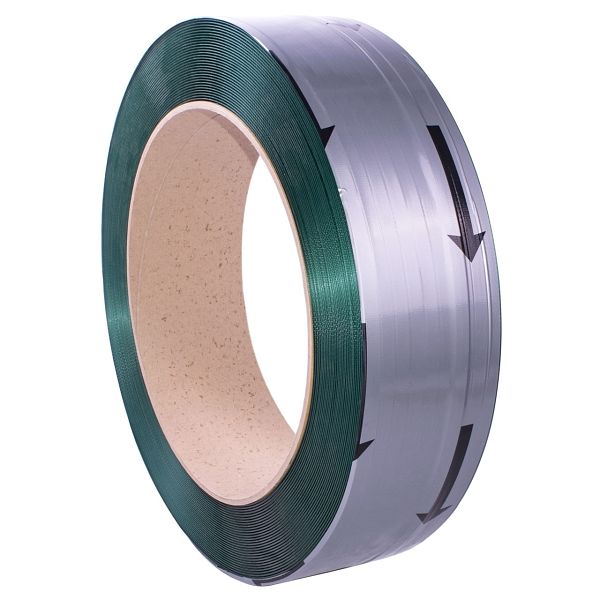
Four straps compared by size
The overview shows the details from our product data. Width and thickness are each listed there with a tolerance, and all four straps have a waffled, which means embossed, surface.
| Strap | Width × thickness | Maximum breaking strength | Core / outer diameter | Coil weight |
|---|---|---|---|---|
| PP, black | 12 × 0.55 mm | 133 kg/daN | core not stated, outer 430/600 mm | 12 kg |
| PP, black | 12 × 0.73 mm | 198 kg/daN | core 200 mm, outer 400 mm | 9 kg |
| PET, green | 12.5 × 0.70 mm | 300 kg/daN | core 406 mm, outer 600 mm | 21 kg |
| PET, green | 15.5 × 0.90 mm | 530 kg/daN | core 406 mm, outer 620 mm | 25.5 kg |
An important point when reading the table: strength depends not only on the dimensions but also on the material. The 12.5 × 0.70 mm PET strap is thinner than the 12 × 0.73 mm PP strap and still has the higher value. So compare dimensions within the same material. The nominal elongation is given as 15-22 % for all four straps. The data on the relevant product page always apply.
Sizing step by step
- Describe the package: Note its weight, shape and sensitivity. A solid stack of timber can take more tension than a carton with soft edges.
- Estimate the stress: Will the package stay in your own warehouse, or travel long distances with several handling stages? The more movement, the more reserve the strap should have.
- Choose the strength: Compare the maximum breaking strength of the straps. Within one material the values rise with width and thickness, while between materials they differ clearly even at similar dimensions.
- Check the tools: Tensioners, seals or the machine must match the strap width and thickness. Clarify this before introducing a new strap size.
- Do a test run: Try the strap on a real package and check the tension, the edges and the seal.
Core and coil: does the strap fit your dispenser and machine?
Besides width and thickness, the core diameter decides whether a coil fits your dispenser or machine. The 12 × 0.73 mm strap has a 200 mm core, the 12.5 × 0.70 mm and 15.5 × 0.90 mm straps a 406 mm core. For the 12 × 0.55 mm strap, the product data do not state a core. Switching between these straps may therefore require a different holder.
The outer diameter and coil weight also matter in daily work. A 9 kg coil is easier to change than one weighing 25.5 kg. When changing coils, make sure you lift safely and that the dispenser stands firmly.
- Core: must fit the holder of the dispenser or machine.
- Outer diameter: must fit into the dispenser.
- Coil weight: affects how easy it is to change coils.
- Packing: the PP straps come with 60 coils per pallet, the PET straps with 48 coils per pallet.
Examples of use
Carton stacks in dispatch
When several light cartons are combined into one unit, a narrow, thinner strap is often enough. The 12 × 0.55 mm strap is a typical starting point here. A thinner strap also puts more metres on the coil: according to the product data, this one has 3,000 m.
Heavy packages in production
For heavy, solid packages such as bundled components on a pallet, high breaking strength is what counts. The 15.5 × 0.90 mm strap has the highest value in this overview. At 25.5 kg, its coil is also the heaviest of the four, which is worth planning for when changing coils.
Frequently asked questions
What does 12×0.73 mm mean?
The first figure is the strap width, the second the strap thickness. The strap is therefore 12 mm wide and 0.73 mm thick.
Is a wider strap always better?
Not necessarily. Within the same material, a wider strap usually offers more strength, but it has to suit the tool, seal and machine. A slightly thicker strap of the same width is often the simpler solution.
What does waffled mean?
Waffled describes the embossed surface of the strap. According to the product data, it ensures a firm hold during transport and storage.
Browse the range
You can find the straps described here directly in our shop:
- PP strapping, 12×0.55mm, black, embossed, 3000m
- PP strapping, 12×0.73mm, black, embossed, 2200m
- PET strapping, 12.5x0.7mm, green, embossed, 2000m
- PET strapping, 15.5x0.9mm, green, embossed, 1500m
All other straps are shown in the strapping bands category. If you are unsure which size suits your package, we are happy to advise you on +49 2237 628095-00, Monday to Friday from 9 am to 5 pm.