
Which ratchet strap is the right one? Three questions decide it: how much lashing capacity does the load need, how long must the strap be, and how is it attached to the vehicle? This guide explains the values on the label and uses examples from our category lashing straps and tension belts to show what to look for when choosing.
What the values on the label mean
Every lashing strap carries a label with technical values. The straps in this guide come from the manufacturer Dolezych, and their product data name the standard EN 12195-2. These are the values you should know:
- LC (lashing capacity): the force the strap may take in a straight pull. It is given in daN.
- STF (standard tension force): the force with which the ratchet pre-tensions the strap. It matters for top-over lashing, where the strap presses the load onto the loading surface.
- Elongation: according to the product data, it is below 5 % for the straps listed here.
- Material: for the DoZurr 1000, 2000 and 5000 models, the product data state that the webbing is made of PES (polyester). The product data for the DoZurr 500 do not state a material.
Important: the number in the product name is not automatically the lashing capacity. The DoZurr 5000 with profile hooks, for example, states an LC of 2500 daN, while the DoZurr 500 with dropside clamp states an LC of 250 daN. What counts is always the value on the label and in the technical data.
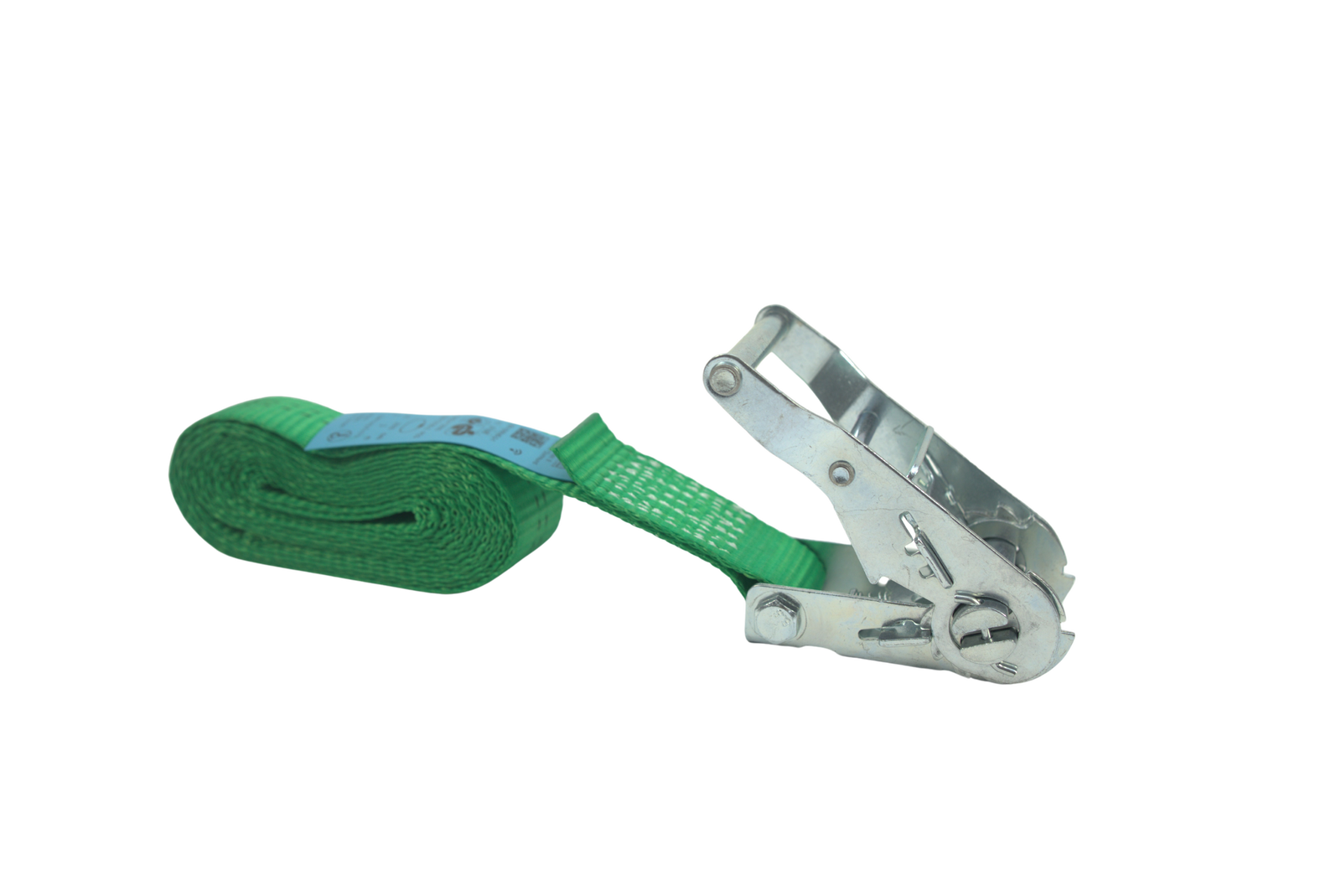
Choosing the right lashing capacity
The capacity you need depends on the weight of the load, the friction between load and loading surface, the lashing method and the number of straps. That is why we give no blanket rule. Calculate the securing according to the rules that apply to your load, then choose a strap whose LC and STF match the result.
As a guide, our examples show the range within the assortment:
- The DoZurr 1000 with pressure ratchet, 1-piece, 4.00 m has 25 mm wide webbing and an LC of 1000 daN.
- The DoZurr 2000 with pressure ratchet, 1-piece, 4.00 m has 35 mm wide webbing and an LC of 2000 daN.
- The DoZurr 5000 with pressure ratchet + profile hook, length: 8 m has 50 mm wide webbing, an LC of 2500 daN and an STF of 300 daN.
Wider webbing spreads the force over a larger area. That helps with sensitive edges, but it does not replace edge protection.
Length and design: 1-piece or 2-piece?
On 1-piece straps, webbing and ratchet form a closed loop. They are suited to bundling goods or wrapping around a load. Both 1-piece DoZurr models listed here are 4.00 m long.
On 2-piece straps, the ratchet sits on a short fixed end, and the long loose end is pulled through the ratchet. Each end carries an end fitting. On the DoZurr 5000 with profile hooks, the fixed end measures 500 mm and the loose end 7,500 mm, giving 8,000 mm in total.
Measure the path of the strap over the load from lashing point to lashing point, and allow some reserve for winding in the ratchet. A strap that is too short cannot be tensioned properly; one that is far too long leaves a lot of loose webbing that you have to stow safely.
The right end fitting
The end fitting has to match the lashing point on the vehicle. Our examples include two types:
- Profile hook: for lashing points and lashing rails that accept a hook. The DoZurr 2000 with pressure ratchet + profile hook, 4.00 m has profile hooks on both ends; its pre-tension force is 220 daN according to the product data.
- Dropside clamp: for vehicles with dropsides. The DoZurr 500 with pressure ratchet + dropside clamp, 3.50 m has a fixed end of 250 mm and a loose end of 3,250 mm.
Before buying, check which lashing points your vehicle has and which forces they may take. The weakest link in the chain sets how much force may act.
Typical applications
Heavy loads on a truck
For machines or building materials on large loading areas, long 2-piece straps with wide webbing are common. The 8 m DoZurr 5000 with profile hooks reaches across wide loads and, according to the manufacturer, can be tensioned with a hand force of 50 daN. Use edge protection and make sure the hooks sit fully in the lashing point.
Vans, trailers and workshops
In a van or on a trailer, distances are shorter and loads are often lighter. Narrower straps with a length of 4.00 m fit well here. Vehicles with dropsides can be used with a dropside clamp. In the workshop, 1-piece straps help to bundle parts before loading.
Frequently asked questions
What is the difference between LC and STF?
LC is the permitted force in a straight pull. STF is the pre-tension force produced by the ratchet. For top-over lashing, STF matters most; for direct lashing, LC is the key value.
Why is a strap called "5000" when its LC is 2500 daN?
The number in the name is a model designation. When choosing, only the values on the label and in the technical data of the product count.
When should a strap be taken out of service?
Check every strap before use for cuts, abrasion, damaged seams, deformed fittings and a readable label. When a strap may no longer be used is set out in the manufacturer's operating instructions.
How to choose your ratchet strap
- Determine the weight and type of the load and the securing it needs.
- Choose LC and STF to match your calculation.
- Measure the length from lashing point to lashing point.
- Choose the end fitting to suit your vehicle.
You will find all models in the category lashing straps and tension belts. We are happy to answer questions about choosing a strap: +49 2237 628095-00, Monday to Friday, 9 am to 5 pm.
This article is a selection guide – the manufacturer's operating instructions apply for use and inspection.