
Push ratchet or pull ratchet? Both tensioning devices tension a lashing strap, but they differ in how they are operated and, above all, in the pre-tension force that finally acts on the load. This comparison sets both designs side by side, using the DoZurr 5000 by Dolezych as the example. You will find all models in our category lashing straps and tension belts.
The differences at a glance
The four straps in this comparison are 2-piece, have 50 mm wide PES webbing and profile hooks on both ends. They differ mainly in the tensioning device.
| Criterion | Push ratchet | DoMulti pull ratchet |
|---|---|---|
| Tensioning device | pressure ratchet | DoMulti long-lever pull ratchet |
| Lashing capacity (LC) | 2500 daN | 2500 daN |
| Standard tension force (STF) | 300 daN | 600 daN |
| Hand force | 50 daN according to the product text | not stated in the product data |
| Lengths | 8.00 m and 10.00 m | 8.00 m and 10.00 m |
| Fixed end | 500 mm on the 8 m strap | 500 mm on the 10 m strap |
The values come from the manufacturer's product data. The label on the strap is authoritative.
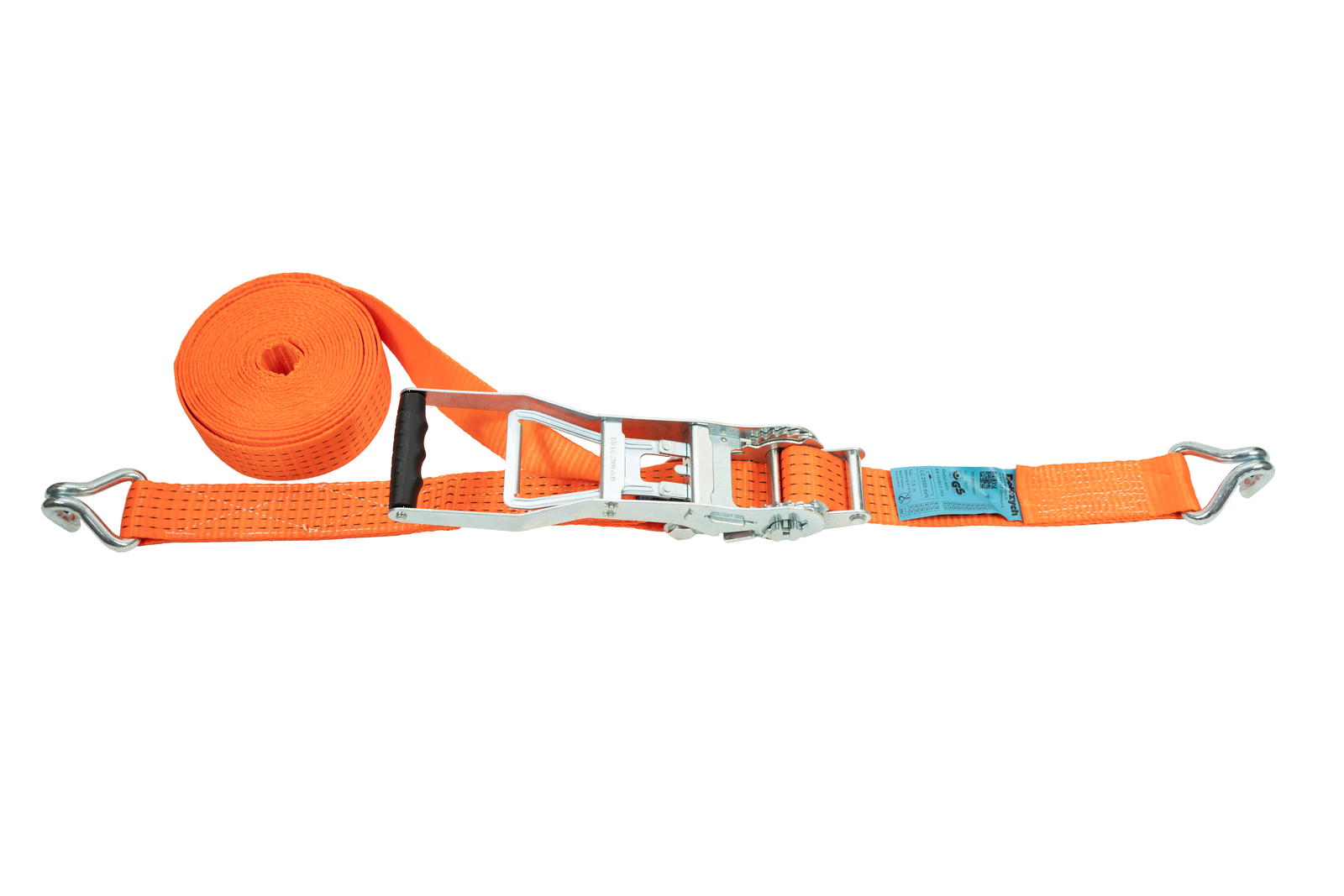
What pre-tension means for top-over lashing
In top-over lashing, the strap runs over the load and presses it onto the loading surface. The friction this creates keeps the load in place. How hard the strap presses depends on the pre-tension force produced by the ratchet. It is shown as STF on the label.
This is the key difference: with the same lashing capacity of 2500 daN, the manufacturer states an STF of 300 daN for the push ratchet and an STF of 600 daN for the DoMulti pull ratchet. According to the product data, the pull ratchet therefore delivers twice the pre-tension force.
How many straps your load needs can only be determined by a calculation under the applicable rules. A higher STF can change the result. Always calculate with the STF value of the strap you actually use.
In direct lashing, on the other hand, the strap connects the load directly to the lashing point on the vehicle. Here the lashing capacity LC counts most. Because both ratchets in this comparison have the same LC of 2500 daN, they differ less in direct lashing than in top-over lashing.
The push ratchet in detail
The push ratchet is compact and fitted to many lashing straps. For the DoZurr 5000 with pressure ratchet + profile hook, length: 8 m, the product text states a hand force of 50 daN; the pre-tension force is 300 daN. The fixed end measures 500 mm, the loose end 7,500 mm.
For longer distances there is the DoZurr 5000 with pressure ratchet + profile hook Nominal length 10,000 mm. It also states an LC of 2500 daN and an STF of 300 daN.
The push ratchet is a good fit if you mainly use direct lashing or if the calculated pre-tension is reached with 300 daN per strap.
The DoMulti pull ratchet in detail
The DoMulti is a long-lever pull ratchet. According to the manufacturer, the long lever is meant to allow comfortable operation with little effort. The DoZurr 5000 with DoMulti towing ratchet + profile hook, 8.00 m states an LC of 2500 daN and an STF of 600 daN.
The DoZurr 5000 with DoMulti towing ratchet + profile hook, 10.00 m has a fixed end of 500 mm and a loose end of 9,500 mm. Its product data name the standard DIN EN 12195-2.
The pull ratchet is a good fit if you often use top-over lashing and want to calculate with the higher pre-tension force. Keep in mind that the long lever needs room when tensioning, for example at the dropside or between closely packed loads.
Typical applications
Top-over lashing of heavy loads on a truck
When a load is lashed across the loading area, such as building materials or machine parts, pre-tension counts. This is where the pull ratchet with its STF of 600 daN shows its advantage. Use edge protection and tension the straps evenly on both sides.
Changing loads in the warehouse and on trailers
For changing loads and shorter distances, the push ratchet is often sufficient. According to the product text, it can be operated with little hand force. For every load, check whether the pre-tension is enough for your calculation.
Frequently asked questions
Is the pull ratchet safer than the push ratchet?
Both straps have the same lashing capacity. A load is secured by the correct calculation, the right lashing method and an inspected strap, not by the type of ratchet alone.
Can I mix straps with different ratchets?
For top-over lashing, different STF values go into the calculation. Calculate each strap with its own value from the label.
Where is the pre-tension force shown?
The STF is printed on the strap's label and listed in the product's technical data. If the label is no longer readable, check the operating instructions to see whether the strap may still be used.
How to make your choice
- Clarify whether you mainly use top-over lashing or direct lashing.
- Calculate the securing your load needs.
- Choose the ratchet whose STF and LC match the calculation.
- Choose the length to suit the path over the load.
You will find all models in the category lashing straps and tension belts. We are happy to answer questions about choosing a strap: +49 2237 628095-00, Monday to Friday, 9 am to 5 pm.
This article is a selection guide – the manufacturer's operating instructions apply for use and inspection.