
Leather glove or coated knitted glove? Both are standard items in warehouses, workshops and on building sites, but they are built for different tasks. Many people associate leather with toughness and coated knitted gloves with grip and dexterity. The EN 388 marking shows that this does not hold across the board. This comparison looks at both types using four models by the manufacturer NITRAS SAFETY. Disposable gloves are deliberately not covered here. You will find the whole range in our category Hand-arm guard.
Leather and knitted at a glance
The details come from the product data. Read the EN 388 marking from left to right. According to the German statutory accident insurance (DGUV) guidance FBFHB-023, the four digits stand for abrasion, cut, tear and puncture; they are followed by a letter from A to F for cut in the TDM test, or an X if no test was carried out by this method. A higher digit stands for a higher performance level.
| Criterion | Leather glove | Coated knitted glove |
|---|---|---|
| Examples | NITRAS APOLLO, NITRAS NAPPA | NITRAS NYLOTEX, NITRAS nylon glove in grey |
| Material | full-grain cowhide with cotton back, nappa leather | nylon with latex or PU coating |
| EN 388 | 3133X (APOLLO), 2111X (NAPPA) | 3131X (NYLOTEX), 4131X (nylon PU) |
| Further marking | NAPPA additionally EN 407 | no further standard in the product data |
| Cuff | canvas cuff on the APOLLO | knitted cuff |
| Size range | 08-12 (APOLLO), size 9 (NAPPA) | 07-12 (NYLOTEX), 06-11 (nylon PU) |
The details on the respective product page always apply.
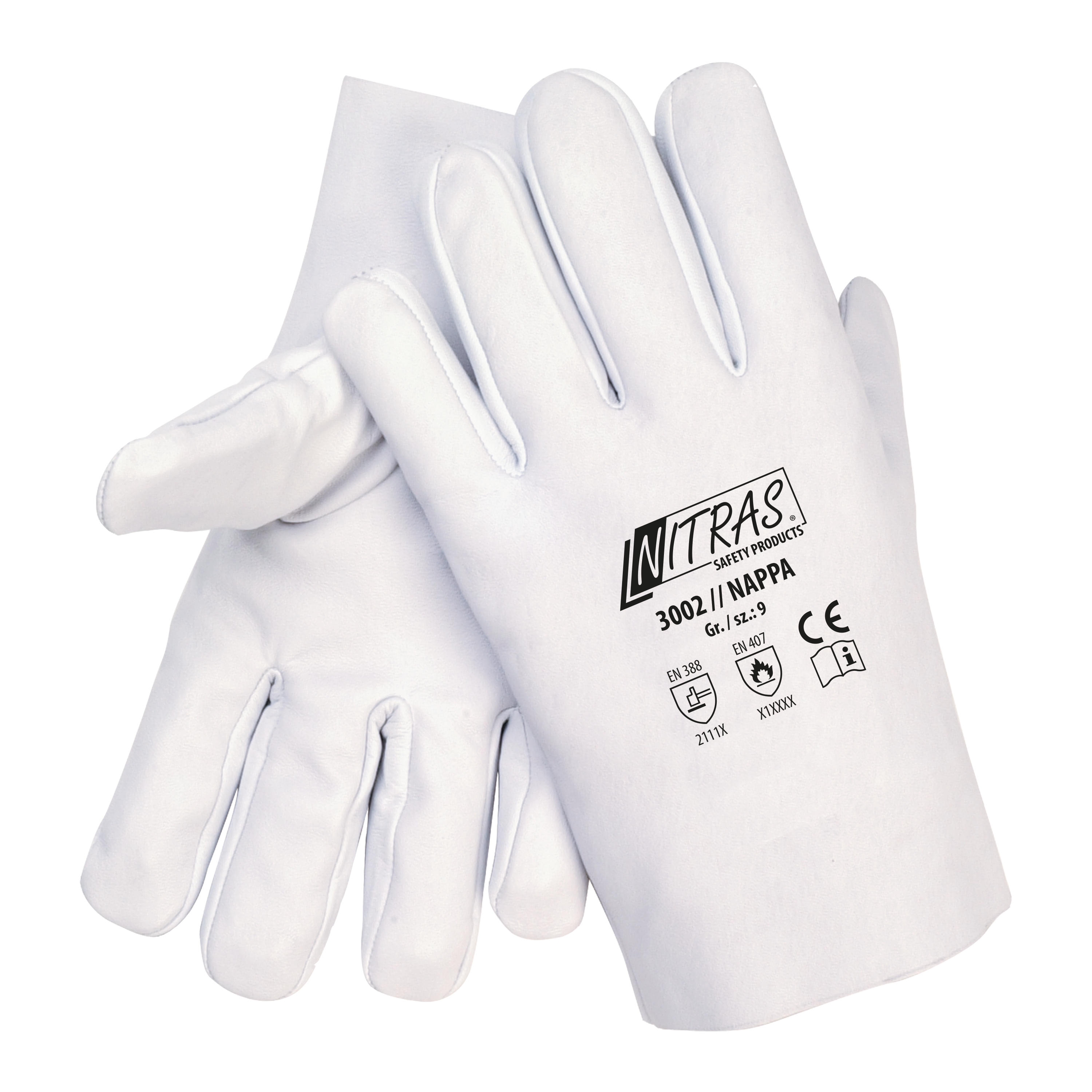
The leather glove: cowhide and nappa
NITRAS APOLLO in full-grain cowhide
The NITRAS APOLLO, cowhide leather gloves, natural colour / grey, EN 388 combines full-grain cowhide with a cotton back; the manufacturer describes it as particularly robust and durable. The palm is lined, and according to the manufacturer the canvas cuff and double seams provide additional safety and durability. With 3133X, it has the highest puncture value in this comparison.
NITRAS NAPPA in full nappa
The NITRAS NAPPA, full nappa gloves, grey, EN 388, EN 407 is additionally marked to EN 407. According to the manufacturer, it protects against contact heat up to 100° C for 15 seconds. Under EN 388 it is rated 2111X, which puts it below the two knitted gloves for abrasion and tear resistance. It is available in size 9.
The coated knitted glove: grip and feel
NITRAS NYLOTEX with latex
The NITRAS NYLOTEX, nylon gloves, grey / black, EN 388 has a black, crinkle-finish latex coating on the palm and fingertips. The manufacturer describes it as particularly grippy and sensitive. Its marking is 3131X.
NITRAS nylon glove with PU
The NITRAS nylon gloves, grey / grey, EN 388 is coated with grey PU on the palm and fingertips and has a knitted cuff. With 4131X, it reaches the highest abrasion value in this comparison.
Which glove for which job?
Warehouse and goods-in
When handling boxes, film and small parts, dexterity and grip are what is needed. Coated knitted gloves with a knitted cuff fit snugly and keep the fingers flexible.
Truck loading with timber and rough goods
Pallets, square timber and rough loads put strain on a glove. Leather is not automatically tougher here: the NAPPA is rated 2111X, the coated nylon glove 4131X. The APOLLO, which the manufacturer describes as particularly robust, has the highest puncture value in this comparison at 3133X and comes with a cuff. Choose by the marking, not by the material.
Workshop with warm workpieces
Where warm parts are touched briefly, the EN 407 marking matters. Among the models presented, only the NAPPA states this rating.
How to make the choice
- Describe the task: fine handling, rough loads or warm parts?
- Compare the EN 388 marking position by position.
- Check whether further risks such as contact heat require an additional marking.
- Choose the right size, because a poorly fitting glove is rarely worn willingly.
We are happy to advise you: +49 2237 628095-00, Monday to Friday from 9 am to 5 pm.
Frequently asked questions
Does a leather glove automatically protect better?
Not in every respect. With 4131X, the nylon glove with PU coating reaches a higher abrasion value than the two leather gloves. So compare the marking rather than the material.
Which glove is suitable for warm parts?
Among the models presented, only the NITRAS NAPPA is marked to EN 407. According to the manufacturer, it protects against contact heat up to 100° C for 15 seconds.
Are the gloves suitable for cut risks?
All four carry an X in the fifth position, so they were not tested for cut in the TDM test, and have cut performance level 1 in the second position, the lowest level. For work with an increased risk of cuts, look specifically at cut-resistant gloves.
Which areas does the manufacturer list for the gloves?
For all four models, the manufacturer lists the same industrial applications: construction and plumbing, chemicals and laboratories, gardening and landscaping, food, vehicle manufacturing, and picking and dispatch. Within these areas, the choice therefore depends on the specific task rather than on the sector.
Are there differences in the cuff?
Yes. The knitted gloves have a knitted cuff, the APOLLO a canvas cuff. Which you prefer depends on the task and how the glove feels to wear.
Conclusion
Leather is not automatically the tougher glove: the markings of the four models show clear differences within both types. The marking is what counts, not the material alone. You will find all models in the category Hand-arm guard.
This article is a selection guide – the manufacturer's operating instructions apply for use and inspection.