
How do you plan warehouse floor marking that stays clear for a long time? Lines on the floor show where goods are placed, where vehicles travel and where care is needed. With marking tape, such lines can be laid quickly and without specialist knowledge. Using tapes from our floor marking and floor repair category, this guide explains how to plan colours and widths, work out the quantity you need and lay the tape correctly.
Lines rather than symbols: what marking tape is for
Floor marking covers two different tasks: symbols that point to a single spot, and lines that define areas and guide routes. This article is about lines. Floor marking tape, which is laid straight from the roll, is made for exactly that.
According to the manufacturer, the Standard tapes from Mehlhose Antirutschprodukte are made of PVC film with a thickness of 0.15 mm. The back is self-adhesive and needs no liner. They are intended for indoor areas with light wear, for example for marking storage locations and traffic routes.
According to the manufacturer's description, the tape is used for marking, securing, guiding, delimiting and blocking off. These five tasks are a good starting point for your own planning.
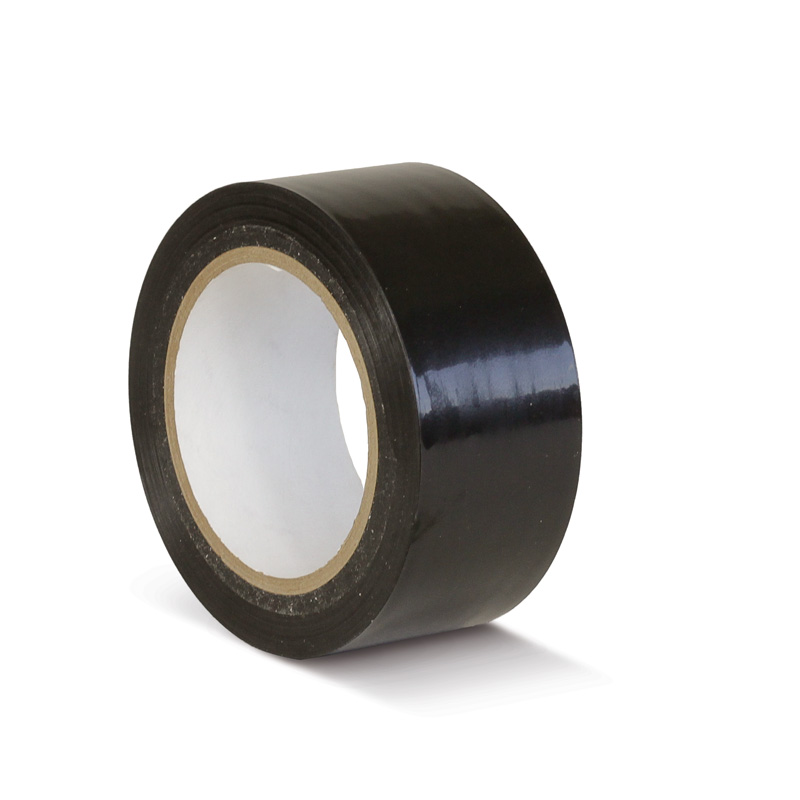
Planning colours: one fixed scheme for the whole site
The tape is available in blue, yellow, green, orange, red, black and white, as well as in black/yellow and red/white hatching. For lines to be understood, each colour should have the same meaning across the whole site.
- Black/yellow hatched: according to the manufacturer, warns of permanent hazards.
- Red/white hatched: according to the manufacturer, warns of temporary hazards such as construction sites.
- Single-colour tapes: suit areas, routes and storage locations. Decide which colour stands for what, and write the scheme down.
- Contrast with the floor: A line only works if it stands out clearly from the surface. On dark floors, light colours are more noticeable.
Before planning, check which requirements apply to your site, and agree the colour scheme with the people responsible for occupational safety.
Choosing width and quantity
The Standard tapes come in two widths, 50 mm and 75 mm, each with 33 m per roll. The wider line is easier to see from a distance. The narrower line suits finer divisions, such as individual storage spaces.
| Tape | Colour | Width | Length per roll |
|---|---|---|---|
| Standard yellow | yellow | 75 mm | 33 m |
| Standard black | black | 75 mm | 33 m |
| Standard black | black | 50 mm | 33 m |
| Standard blue | blue | 50 mm | 33 m |
To work out the quantity, measure all lines of one colour and width on the plan, add them up and divide the total by 33 m. Round up and allow some reserve for offcuts at corners and for later repairs. According to the manufacturer, the tape can be stored for 24 months.
Preparing the floor and laying the tape
- Check the surface: The floor must be clean and dry. On concrete, wood and asphalt, the manufacturer recommends a primer.
- Watch the temperature: According to the manufacturer, the tape is laid at +12 degrees Celsius or above.
- Mark out the lines: Mark the course in advance so that the lines are straight and even.
- Apply the tape: The tape is laid by hand or with a floor marking applicator and pressed down firmly.
- Let it set: The tape can be walked on immediately, takes full load after 6-8 hours and reaches maximum adhesion after 72 hours, depending on temperature and humidity.
Examples of use
Storage locations and racking aisles
In the warehouse, lines show where pallets are set down and which areas must stay clear. A narrow tape in a fixed colour neatly marks out individual storage spaces. Before laying, decide which colour means what, so that all storage spaces are marked consistently.
Traffic routes and hazard points in production
In production, lines separate traffic routes from work areas. Wider tapes are easier to see from a distance here. Keep in mind here too: according to the manufacturer, the Standard tapes are designed for indoor areas with light wear. Check the technical data sheet before using them on routes with heavy traffic. Permanent hazard points can be marked with black/yellow hatching, temporary areas such as construction sites with red/white hatching.
Frequently asked questions
Can I use the tape outdoors?
According to the manufacturer, the Standard tapes are intended for indoor areas with light wear. For other areas, check the details in the technical data sheet.
When can the tape take load?
The tape can be walked on immediately and takes full load after 6-8 hours. It reaches maximum adhesion after 72 hours. Bear in mind that the Standard tapes are designed for areas with light wear.
Which width should I choose?
For routes and large areas, the wider 75 mm line tends to suit better, for fine divisions the narrower 50 mm line. What matters is that you stay consistent across the site.
Browse the range
You can find the tapes mentioned here directly in our shop:
- Floor marking tape standard yellow 75mm x 33m
- Floor marking tape standard black 75mm x 33m
- Floor marking tape standard black 50mm x 33m
- Floor marking tape standard blue 50mm x 33m
More colours and products are shown in the floor marking and floor repair category. We are happy to answer questions about planning on +49 2237 628095-00, Monday to Friday from 9 am to 5 pm.