
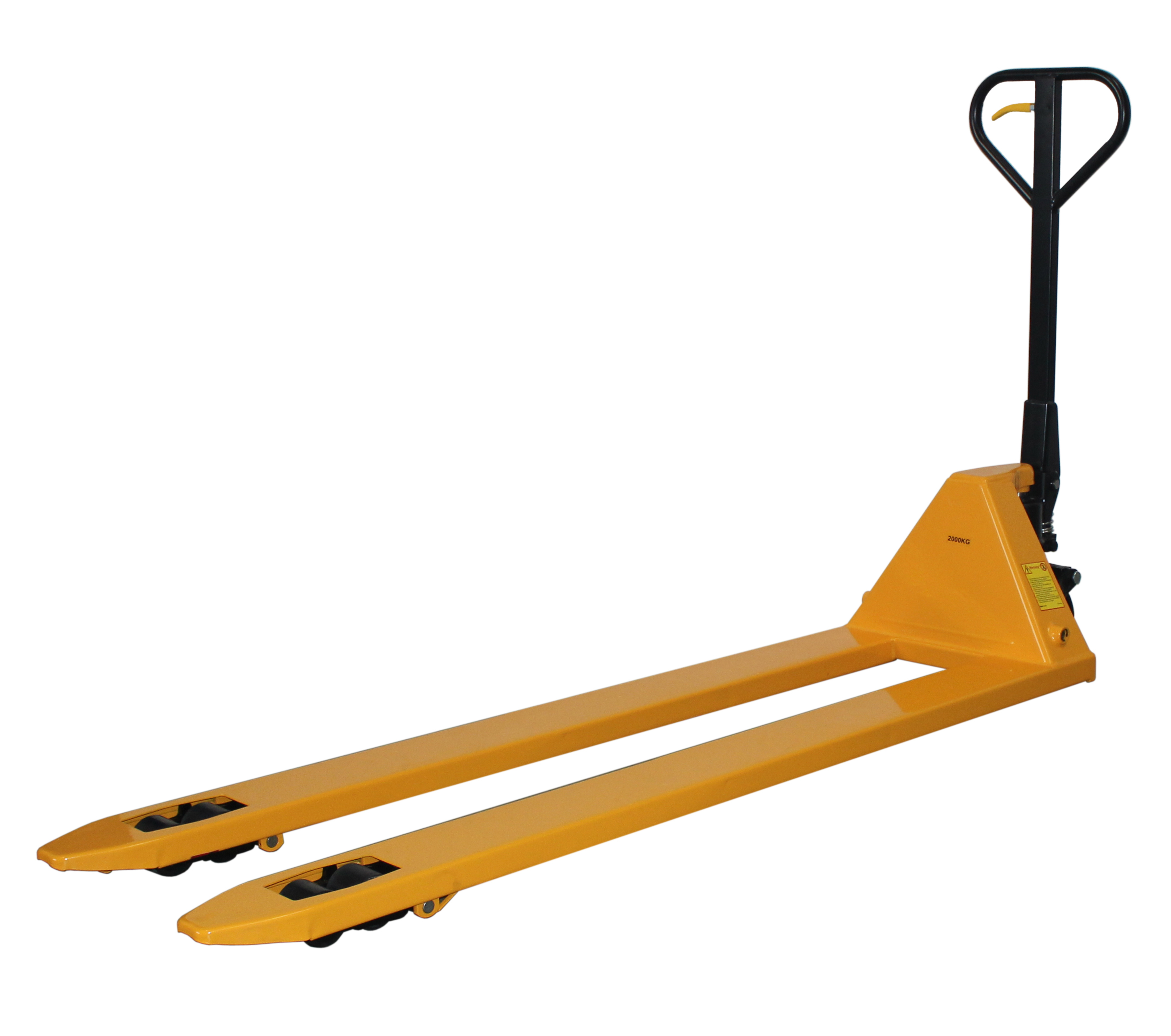
Standard pallet truck too short? If you want to move long goods such as profiles, panels or racks, or several load units one behind the other, common fork lengths soon reach their limits. Extra-long pallet trucks close this gap. This guide explains what matters with fork lengths from 1,500 to 2,500 mm and presents the matching models from our category Pallet truck.
When an extra length makes sense
The fork length should match the load. If the forks are much shorter than the goods, the load overhangs the fork tips and rests unsteadily. If they are much longer, the truck needs more space than necessary when manoeuvring. The manufacturer qteck describes its special-length pallet trucks in exactly this way: when correctly matched to the actual dimensions of the load, the space needed for manoeuvring and moving is kept to a minimum.
Double pallets and pallets in a row
The product data do not state whether two pallets in a row fit on a particular fork length. So compare the total length of your load with the fork length. The manufacturer's figures for load capacity and load centre apply to the entire load on the forks. With several pallets in a row, check in the operating instructions or with the manufacturer whether your load is covered.
Long and bulky goods
For long goods, machines or large pallets, the manufacturer explicitly names the models with 2,000 and 2,500 mm fork length. It is important that the load is evenly distributed and does not tip sideways over the forks.
The models at a glance
All pallet trucks presented here have a fork carriage width of 540 mm, a lifting range of 85-200 mm, steering wheels Ø180x50 mm and tandem load rollers Ø80x70 mm made of polyurethane.
- qteck® pallet truck 1300mm 2.5 tonnes PU/PU tandem: maximum load capacity 2,500 kg, load centre 650 mm, tare weight 76 kg.
- qteck® pallet truck 1500mm 2.0 tonnes PU/PU tandem: maximum load capacity 2,000 kg, load centre 750 mm, tare weight 82 kg.
- qteck® pallet truck 1800mm 2.0 tonnes PU/PU tandem: maximum load capacity 2,000 kg, load centre 900 mm, tare weight 88 kg.
- qteck® pallet truck 2000mm 2.0 tonnes PU/PU tandem: maximum load capacity 2,000 kg, load centre 1,000 mm, tare weight 105 kg.
- qteck® pallet truck 2500mm 2.0 tonnes PU/PU tandem: maximum load capacity 2,000 kg, load centre 1,250 mm, tare weight 123 kg.
The 1,300 mm model is not an extra length in the strict sense, but it shows well how load capacity and tare weight change with fork length.
Understanding load centre and load capacity
The load centre grows with the forks
The load centre is the distance from the fork heel for which the manufacturer states the rated load capacity. According to the product data, on the qteck models it equals half the fork length: from 750 mm at 1,500 mm fork length to 1,250 mm at 2,500 mm. If the centre of gravity of your load lies further forward, it is not automatically covered by this rating – the operating instructions are decisive.
More length, more tare weight
Every extension adds tare weight, from 82 kg on the 1,500 mm model to 123 kg on the 2,500 mm model. You will notice this when pushing off and turning. With long forks, also allow more space for bends and aisle changes.
Typical applications
Warehouse with long load units
If you bring long load units, or units standing one behind the other, to goods-in or to the loading ramp, choose the fork length according to the actual length of the load. Check the weight and the position of the centre of gravity against the truck's load capacity and load centre beforehand.
Production with long components
Panels, profiles or racks can be moved more steadily with 2,000 or 2,500 mm forks because they are better supported. According to the manufacturer, the hydraulics allow controlled lowering even of heavy loads.
Workshop with special load carriers
Workshops often use their own racks in unusual sizes. A fork length of 1,500 or 1,800 mm often fits better here than the standard size while remaining easy to handle.
How to choose the right fork length
- Measure the longest load you move regularly and the spacing of the entry openings.
- Choose forks on which the load rests well without the forks protruding unnecessarily.
- Compare your heaviest load with the maximum load capacity and the load centre.
- Check aisle widths and turning areas for the chosen length.
- Consider the floor: according to the manufacturer, the polyurethane wheels are quiet and gentle on floors.
We are happy to advise you: +49 2237 628095-00, Monday to Friday from 9 am to 5 pm.
Frequently asked questions
Does a long pallet truck carry less?
For the models shown here, yes: the 1,300 mm model is rated at 2,500 kg, the models from 1,500 mm at 2,000 kg. The specification on the product page always applies.
Can I move single pallets with long forks?
In principle yes, but the forks then protrude behind the pallet. This costs space when manoeuvring. If you mainly move single pallets, shorter forks are more practical.
Which wheels do the models have?
All models in this article have polyurethane steering wheels and load rollers, with the load rollers in tandem. According to the manufacturer, the wheels have ball bearings.
What should I check before use?
Before every use, check forks, wheels and hydraulics for visible damage, and observe the manufacturer's specifications on load capacity and load centre.
Conclusion
Extra-long pallet trucks pay off if you regularly move long goods or long load units. The right fork length, the load centre and enough room to manoeuvre are what count. You will find all models in the category Pallet truck.
This article is a selection guide – the manufacturer's operating instructions apply for use and inspection.