
Disposable nitrile glove or nitrile-coated work glove? Both have the word nitrile in their name, yet they are built in completely different ways. One consists entirely of a thin nitrile layer and is thrown away after use, the other is a knitted glove with a nitrile coating where it takes the most wear. Using models from our hand and arm protection category, this comparison shows how the two designs differ and when each one fits.
The differences at a glance
The values come from the NITRAS SAFETY manufacturer information for our products. We name specific models rather than general ranges, because gloves vary a great deal from model to model.
| Criterion | Disposable nitrile glove | Nitrile-coated work glove |
|---|---|---|
| Example | NITRAS SUPREME NITRILE and NITRAS TOUGH GRIP N | NITRAS nitrile gloves, white / yellow |
| Construction | made entirely of nitrile, non-sterile, powder-free, with rolled edge | knitted polyester glove with 3/4 nitrile coating and knitted cuff |
| Surface | micro-roughened (SUPREME NITRILE) or scaly surface (TOUGH GRIP N) | yellow nitrile coating on a white liner |
| Marking | EN ISO 374, the SUPREME NITRILE also protects against viruses to ISO 374-5 | EN 388 with the code 3121X |
| Sizes | S to 2XL, ambidextrous | 07 to 11 |
| Pack | box of 100 or box of 50 | 144 pairs per packaging unit |
Please note: the markings of the two designs refer to different standards and therefore cannot be compared directly. The relevant product page with the current data sheet always applies.
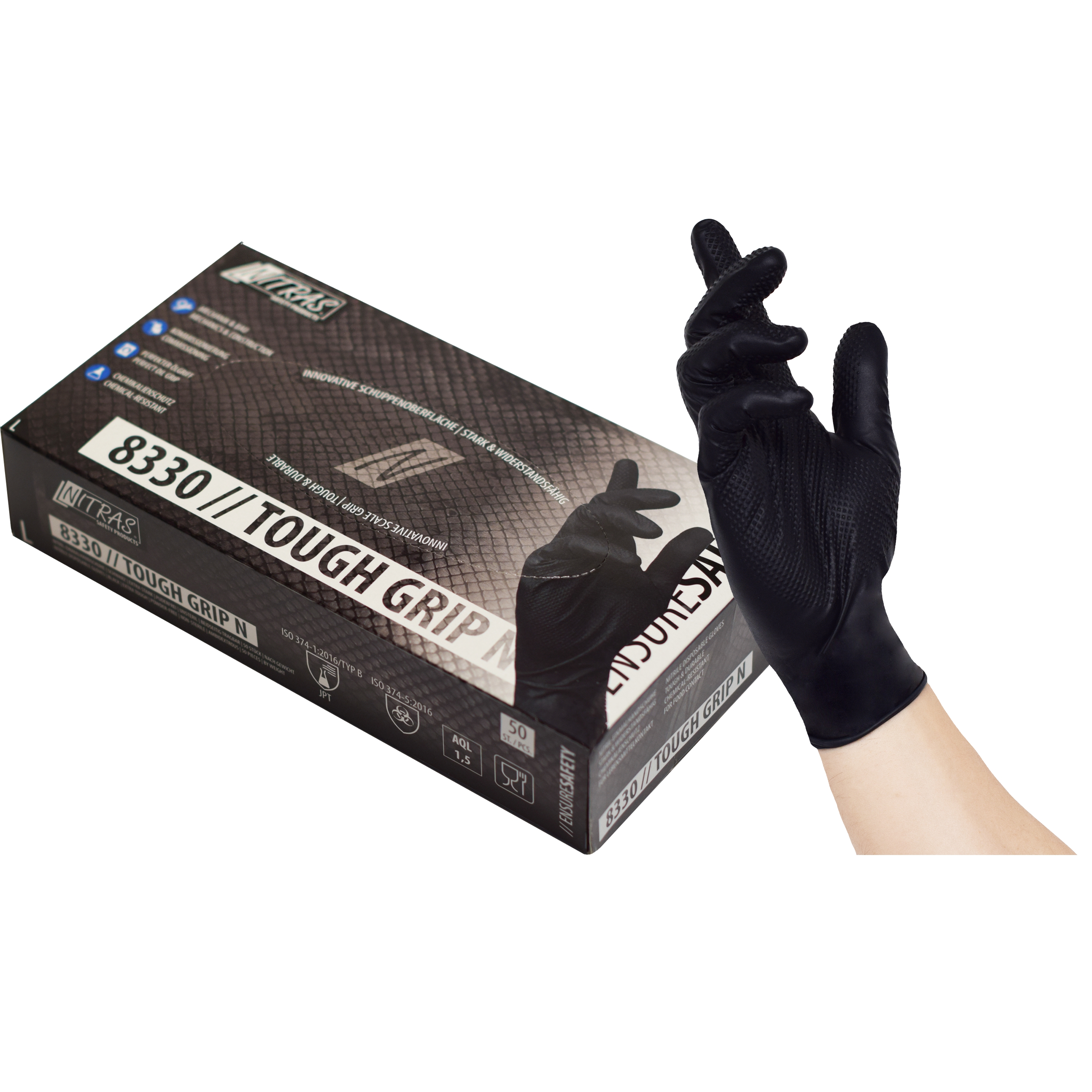
Disposable nitrile gloves: thin, sensitive, quickly changed
Disposable nitrile gloves are meant for short tasks, after which the glove is thrown away. They fit closely and leave plenty of feel for small parts. Because they are ambidextrous, you simply take the next glove out of the box.
According to the manufacturer, the blue NITRAS SUPREME NITRILE is non-sterile and powder-free, manufactured to EN 455 and specified with AQL 1.5. It is certified to EN ISO 374 and, according to the data sheet, protects against viruses to ISO 374-5. Its micro-roughened surface is designed to combine grip with sensitivity.
The black NITRAS TOUGH GRIP N relies on a scaly surface which, according to the manufacturer, gives a strong grip on wet and dry surfaces. It is also non-sterile, powder-free, suitable for food contact and marked to EN ISO 374.
Nitrile-coated work gloves: liner and coating
A coated work glove consists of two layers: a knitted liner that surrounds the hand, and a coating that provides grip and protection where the glove takes the most wear. How far the coating extends varies from model to model and is given in the product data.
The NITRAS nitrile gloves in white / yellow have a polyester liner and a yellow 3/4 nitrile coating. According to the manufacturer, the knitted cuff ensures a secure fit. They are marked to EN 388 with the code 3121X.
An alternative with a different coating is the NITRAS nylon gloves in grey. They are coated with PU rather than nitrile, and only on the palm and fingertips. According to the manufacturer, they suit work that calls for a high degree of sensitivity. Their marking is EN 388 with the code 4131X.
Which glove for which task?
Warehouse and order picking
When handling boxes, crates and small parts over a whole shift, a coated work glove is often the more comfortable choice, because the liner and knitted cuff enclose the hand. A disposable glove fits better for short steps here, such as handling dirty parts, after which the glove is changed anyway.
Laboratory, workshop and food areas
Where gloves are changed often and EN ISO 374 marking is required, disposable gloves come into their own. According to the manufacturer, both disposable models shown here are suitable for food contact. For wet parts, the scaly surface of the TOUGH GRIP N can be useful, which according to the manufacturer grips on wet and dry surfaces. In every case, check whether the marking suits your substances.
What to consider when deciding
- Length of the task: Short, changing tasks point to the disposable glove, longer periods of continuous work rather to the coated work glove.
- Hazard: Use your risk assessment to decide which marking is required. EN ISO 374 and EN 388 describe different tests.
- Grip: A textured surface can help with wet parts, while sensitivity matters for small parts.
- Size: The disposable gloves here come in S to 2XL, the coated work gloves in numbered sizes.
- Condition: Check every glove before use. Damaged gloves are replaced.
Frequently asked questions
Is a nitrile-coated work glove a chemical protective glove?
Not automatically. The model shown here is marked to EN 388, not to EN ISO 374. When working with chemicals, what counts is the marking in the data sheet, not the word nitrile in the name.
Can I wear a disposable glove more than once?
Disposable gloves are intended for single use. Change them after the task and whenever they are damaged or dirty.
Why can the disposable glove be worn on either hand?
It has a symmetrical shape and therefore fits the left hand as well as the right. This saves time when putting gloves on and changing them.
Browse the range
You can find the compared models directly in our shop:
- NITRAS SUPREME NITRILE, disposable nitrile gloves, blue, EN ISO 374, box of 100
- NITRAS TOUGH GRIP N, disposable nitrile gloves, black, EN ISO 374, box of 50
- NITRAS nitrile gloves, white / yellow, EN 388
- NITRAS nylon gloves, grey / grey, EN 388
More models are available in the hand and arm protection category. This article is a selection guide – the manufacturer's operating instructions apply for use and inspection. We are happy to advise you on +49 2237 628095-00, Monday to Friday from 9 am to 5 pm.