
What sets an automatic tie-down strap apart from a classic ratchet strap? With an automatic strap, the loose end of the webbing is retracted by itself after use instead of hanging around or having to be wound up by hand. Using the DoMatik straps from Dolezych in our lashing straps / tension belts category, this guide explains how the principle works, what values the models have and when an automatic strap pays off compared with a classic lashing strap.
What is an automatic tie-down strap?
An automatic tie-down strap, which the manufacturer also calls an automatic ratchet lashing strap, is a lashing strap with a ratchet and built-in webbing retraction. The DoMatik models are two-piece: they consist of a short fixed end of 300 mm and a loose end of 4,700 mm, giving a total strap length of 5,000 mm.
The difference from a classic strap lies in the handling. According to the manufacturer, the automatic webbing retraction and a stop mechanism make the strap quick and easy to use. The webbing no longer has to be rolled up by hand, and no long loose ends are left lying on the load area.
The straps are made of polyester (PES) and are tensioned with a push ratchet. The product data give the elongation as less than 5 %.
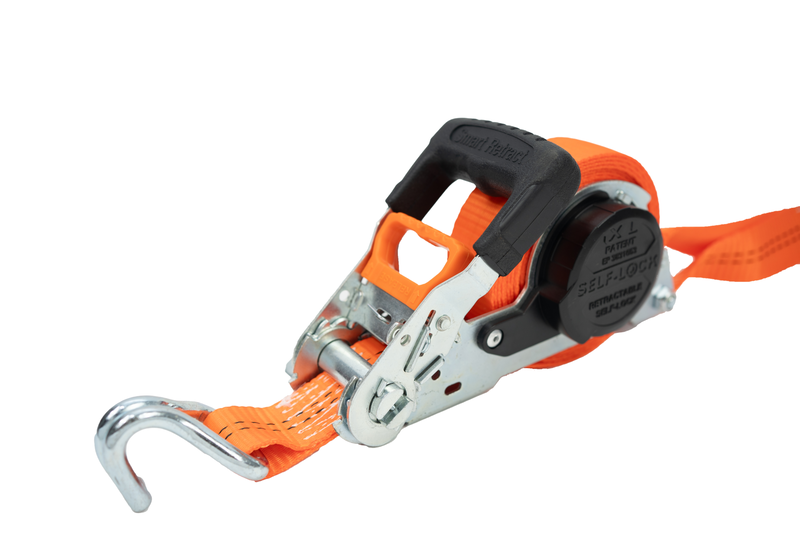
How DoMatik works in practice
- Hooking in: The end fittings are hooked into suitable lashing points. On the DoMatik 25 these are PVC-coated S-hooks, on the DoMatik 35 profile hooks.
- Pulling out and tensioning: The webbing is pulled out to the length you need and then tensioned with the push ratchet.
- Releasing and retracting: After release, the strap retracts the webbing automatically. According to the manufacturer, the stop mechanism is part of this function.
- Storing: Because the webbing stays rolled up in the strap, it is quickly stowed and ready to hand for the next job.
The exact operation, releasing under tension and the check before use are described in the manufacturer's operating instructions. Follow them every time you use the strap.
The models at a glance
The overview shows the two DoMatik straps and, for comparison, two classic DoZurr straps without automatic retraction. All values come from our product data.
| Detail | DoMatik 25 | DoMatik 35 | DoZurr 250 | DoZurr 1000 |
|---|---|---|---|---|
| Design | 2-piece, automatic | 2-piece, automatic | 1-piece | 1-piece |
| Webbing width | 25 mm | 35 mm | 25 mm | 25 mm |
| Tensioning element | push ratchet | push ratchet | strap clamp | push ratchet |
| Lashing capacity (LC) | 350 daN | 1,000 daN | 250 daN | 1,000 daN |
| Standard tension force (STF) | 119 daN | 280 daN | not stated | not stated |
| Strap length | 5,000 mm | 5,000 mm | 2,500 mm | 4,000 mm |
| Colour | red | orange | red | blue |
The product data list the standard EN 12195-2 for the DoMatik 35, DoZurr 250 and DoZurr 1000. For the DoMatik 25, the entry reads "based on EN 12195-2". The label on the strap and the product page always apply.
When an automatic strap pays off
An automatic strap shows its advantages wherever loads are lashed and released often. The more often a strap is used each day, the more it matters that the webbing does not have to be wound up by hand and that no loose ends get in the way.
- Frequent load changes: With many stops for loading and unloading, the strap is quickly released and stowed again.
- A tidy load area: Rolled-up straps do not tangle and are ready to hand for the next job.
- Length as needed: On the DoMatik straps, the loose end is 4,700 mm long. How far you pull it out depends on the load.
If loads are lashed only rarely, the automatic retraction matters less, and a classic strap can fit just as well. The product data describe the one-piece DoZurr 250 with strap clamp for logistics and shipping, among other uses, for example for pallets and machine components. For the one-piece DoZurr 1000 with push ratchet and a length of 4,000 mm, they list furniture, building site materials or machines, for example.
Examples of use
General cargo on the truck
In distribution traffic, the load is secured again at every stop. This is where the DoMatik 35 shows its strengths: two-piece, with profile hooks and a lashing capacity of 1,000 daN. After release, the webbing rolls back and the load area stays free of loose strap ends.
Vans for workshop and installation work
Vans often carry toolboxes, materials and smaller equipment that need securing. The DoMatik 25 with 25 mm webbing, S-hooks and a lashing capacity of 350 daN is intended, according to the product data, for tools, furniture and building materials in vans, among other uses. Whether its values are sufficient for your load follows from your load securing plan. Check whether the lashing points in the vehicle suit the hooks.
Frequently asked questions
What do LC and STF mean?
In the product data, LC stands for the permitted lashing capacity and STF for the standard tension force. The values your load needs follow from the load securing plan for the vehicle and the load in question.
Do I need more force to tension the strap?
The product data give a hand force of 25 daN for the DoMatik 25 and 50 daN for the DoMatik 35. How to operate the ratchet is described in the operating instructions.
Does an automatic strap replace the check before use?
No. How a strap is to be checked before use, and when it may no longer be used, is set out in the manufacturer's operating instructions. This applies to automatic straps just as it does to classic straps.
Browse the range
You can find the straps described here directly in our shop:
- DoMatik 25 automatic tensioning belt
- DoMatik 35 automatic ratchet lashing strap
- DoZurr 250 with strap clamp, 1-piece, 2.50 m
- DoZurr 1000 with pressure ratchet, 1-piece, 4.00 m
All other straps are shown in the lashing straps / tension belts category. This article is a selection guide – the manufacturer's operating instructions apply for use and inspection. We are happy to advise you on +49 2237 628095-00, Monday to Friday from 9 am to 5 pm.